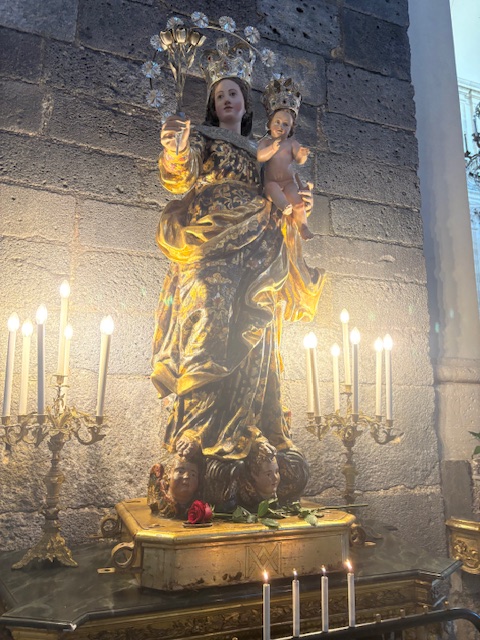
Tag: Sicily travels

  • Ortigia, Sicily, Italy: Italy Dreams’ Recommendations on What to Do and See on This Beautiful Island

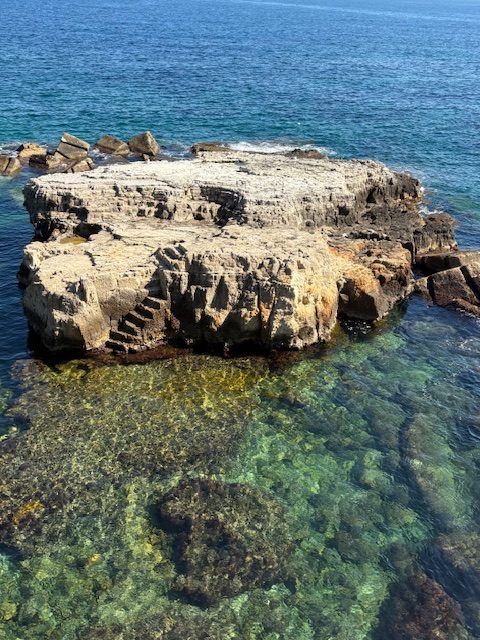
    The water in beautiful Ortigia, Sicily.

    If you’re visiting eastern Sicily, make Ortigia part of your itinerary. It’s filled with history, a bustling market, and sunny, scenic views.

    The island of Ortigia is just a little under one square kilometer but packed with plenty to see. It’s part of the city of Siracusa and considered Siracusa’s “Old Town.”

    It’s south of Catania–home to Mount Etna and the Catania Airport–but north of the Baroque-style town of Noto.

    In English, the names Ortigia (or-tee-ja) and Siracusa are Ortygia and Syracuse, but we’ll stick with the Italian names for these cities in our story.
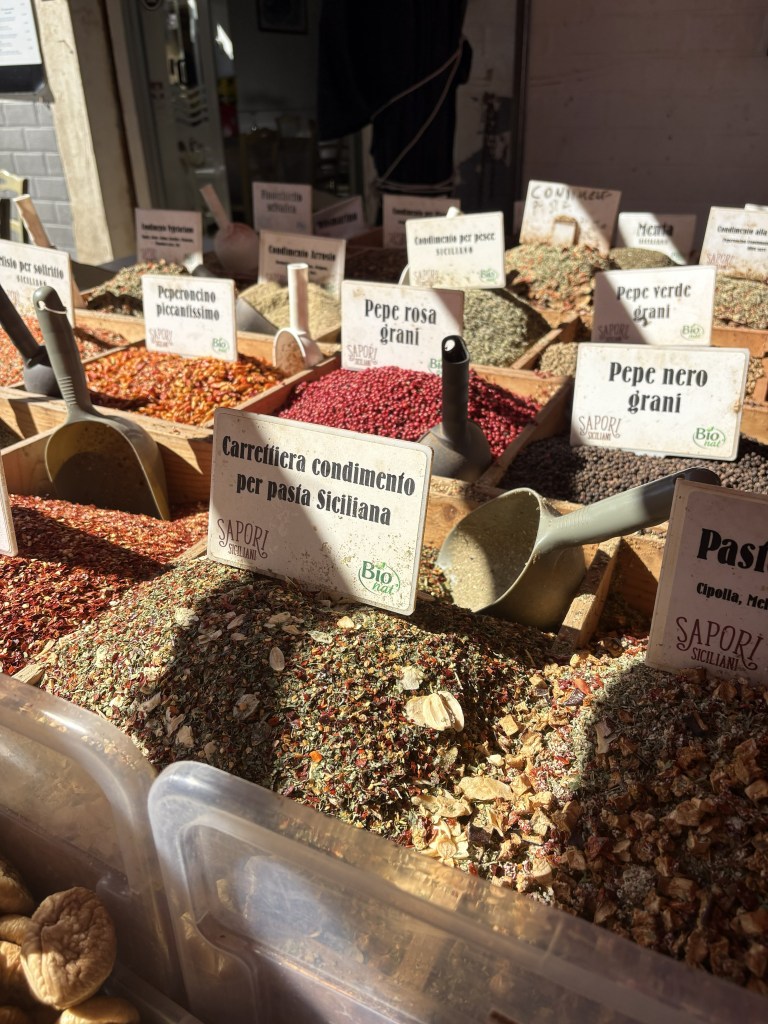
    Spices for sale at the Ortigia Market.

    A Little Ortigia History for Starters

    Ortigia’s history traces back more than 3,000 years. The area was considered part of ancient Greece, and mathematician and inventor Archimedes was born there in 287 BCE–and subsequently died there helping to protect the city against Roman conquerors.

    The name Ortigia comes from Greek–“ortyx” means quail in Greek.

    The Romans conquered Siracusa in 212 BCE, and, like the rest of Sicily, the area went on to be conquered by Byzantines, Arabs, Normans, and the Spanish.

    A major earthquake affected the area in 1693 (we’ve written about it before in our stories about Noto and Val di Noto). As tragic as that was, the subsequent Baroque rebuild gave the area its current classic, historical look.
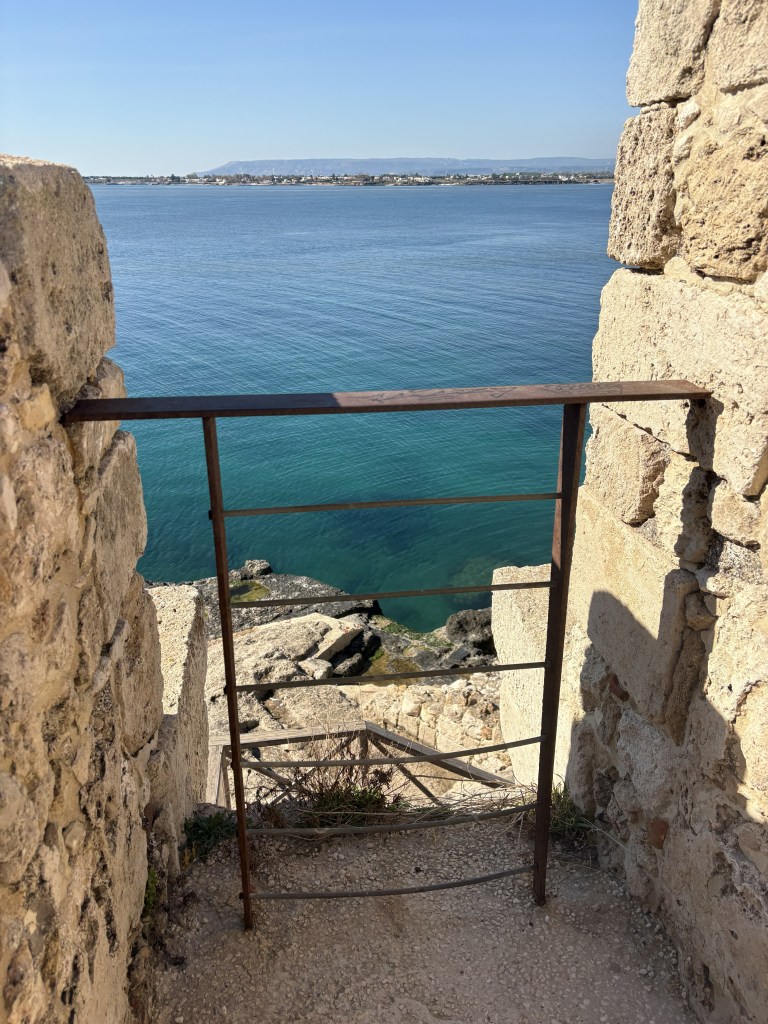
    A view from Maniace Castle/Castello Maniace.

    5 Things to Do in Ortigia, Sicily

    There’s a lot you can do in Ortigia, and we share here our highlights from an early 2026 visit. This was before high tourist season, but it was a sunny, mild day with decent foot traffic.

    We didn’t have a chance to explore other parts of Siracusa.

    Note that I was traveling solo throughout the trip but I use “we” in the article just to avoid overusing “I”.

    Andiamo/let’s go!
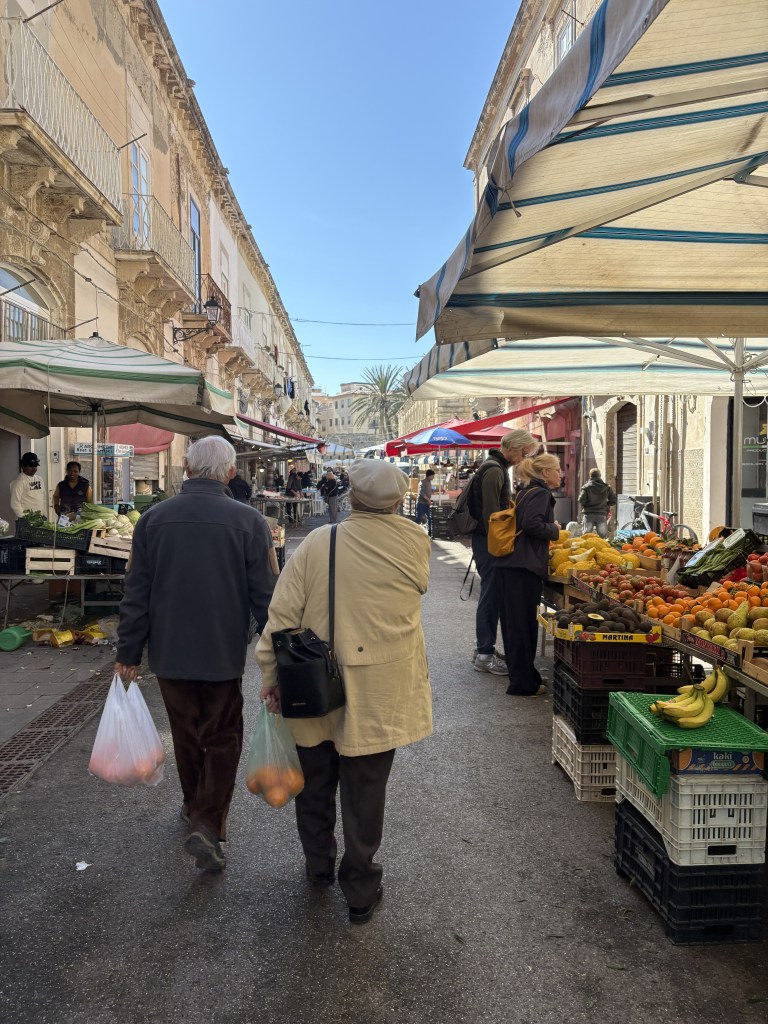
    The Ortigia Market/Mercato di Ortigia in Sicily.

    Ortigia Market/Mercato di Ortigia

    In our home state of Florida, we visit and write about a lot of farmers markets. We also love to write about food because….well, do we need to explain why?!

    So, it makes sense that the Ortigia Market (Mercato di Ortigia) was a big highlight of our visit to Ortigia. This outdoors market is open Monday to Saturday from 7:30 a.m. to 1:30 or 2 p.m. and spans several blocks.

    You’ll find a mix of tourist-geared items like olive oil, souvenirs, and sweet treats along with daily staples like fish, cheese, spices, and produce. It’s a market frequented by locals and visitors alike.
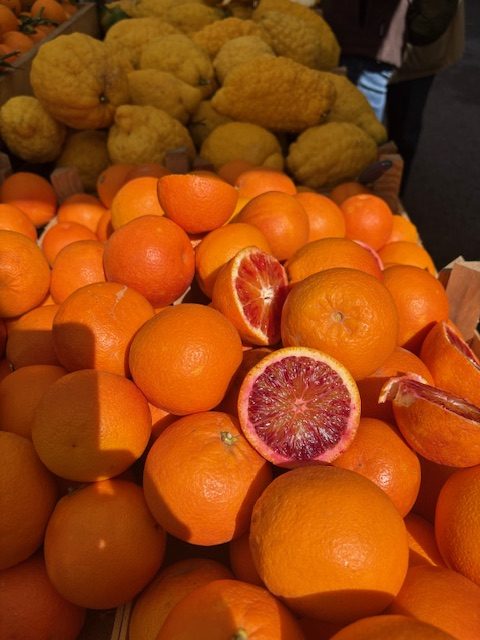
    Citrus fruits at the Ortigia Market.

    It was terrific to get a mini-culinary, self-guided tour of Sicily’s produce through the market, with fresh oranges, tomatoes from Pachino, strawberries, and other freshly-grown items. It’s funny how much the produce grown in Sicily parallels what’s grown where we live in Florida.

    I’ve read how some markets in Sicily have an Arabic-type feel, with vendors singing to beckon visitors to their stands. There was at least one fish/seafood vendor who did this, and we have since seen videos of him on Instagram.
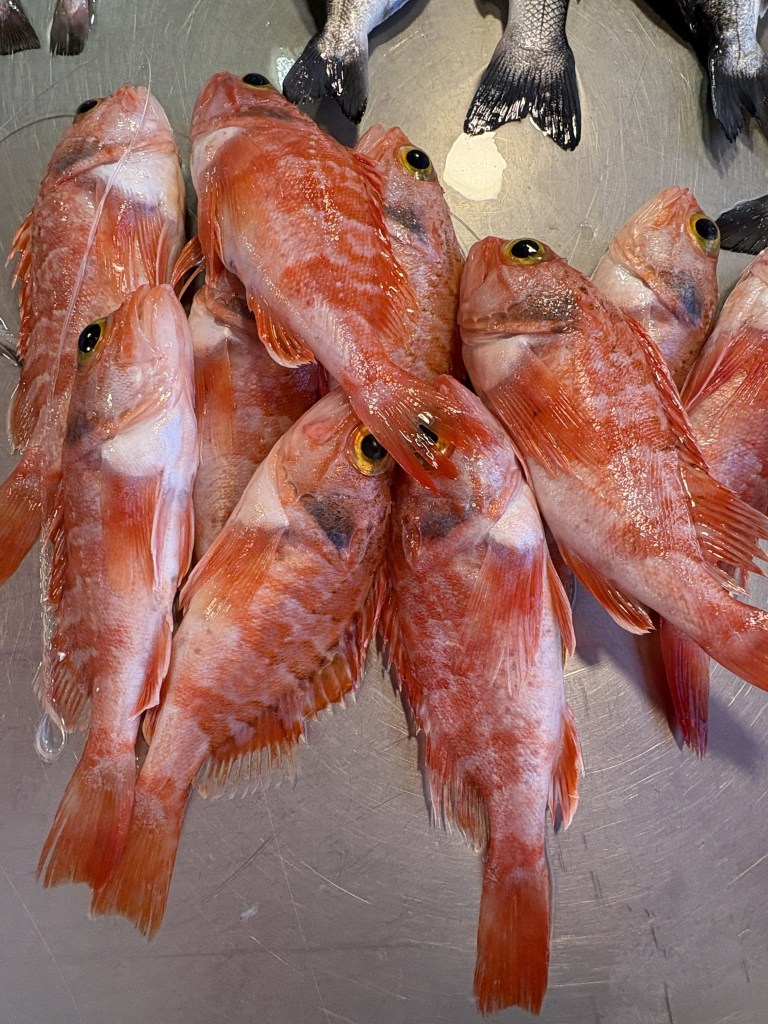
    Fish at the Ortigia Market.

    Right beside the market is the historical Graziella Fishermen District/Graziella Quartiere dei Pescatori. It once housed the fishermen who worked in the area. Today, the homes along its alleyways still are well-lived in.

    Strolling around the district was another highlight of our Ortigia time and gave us a real sense of daily life as they cleaned, watched TV, or talked to each other. We could hear it all from outside their doors.

    Just be respectful if you go. We saw an angry sign in Italian and English from a resident reminding visitors to pick up their “fithy rubbish” instead of letting it dirty their community.
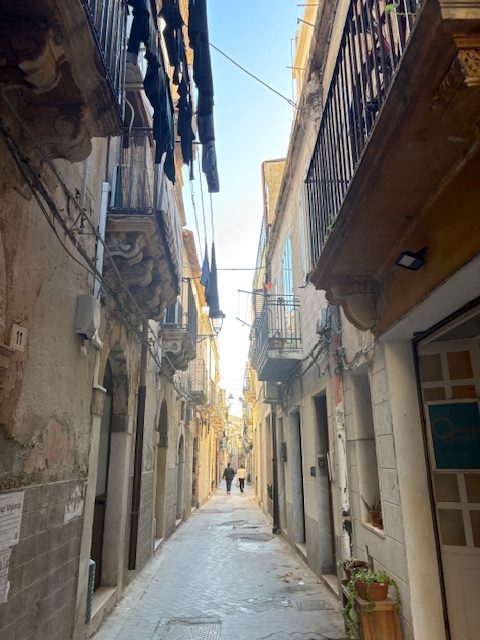
    Inside the Graziella Fishermen District.

    Walk Along the Water

    If you’d rather wander and see where it takes you, you can absolutely do that in Ortigia.

    There’s a walking path that will take you somewhat consistently around the island, and you can admire the island’s homes, people, and the beauty of the Ionian Sea.

    Ortigia also has steep stairs that will take you to crevice-like beach areas. There were some people enjoying the sun in those areas during our visit, which was a mild day for late February. The water was inviting, but it was too early in the year for beach-day vibes.
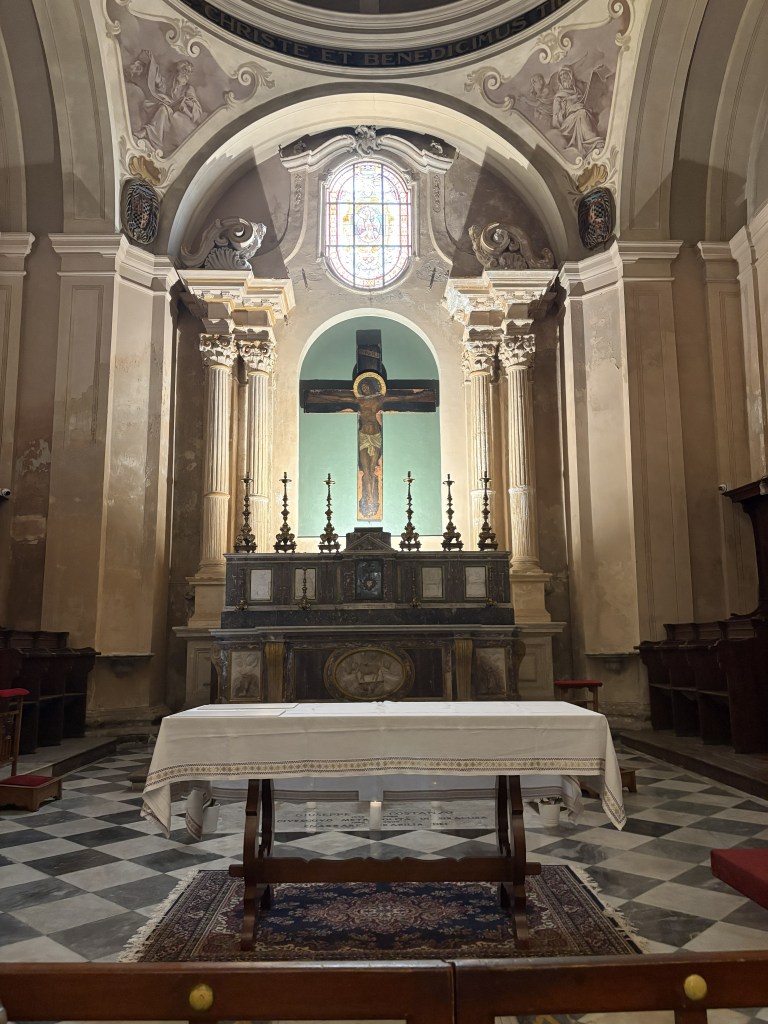
    Inside the Cathedral of Siracusa.

    Cathedral of Siracusa/Duomo di Siracusa

    The Duomo di Siracusa/Cathedral of Siracusa, located right in the heart of Ortigia, reflects Ortigia’s ancient Greek heritage as it was originally built as a Greek temple.

    It now has a Baroque-style facade and is definitely worth of a visit when you’re in Ortigia.

    The cathedral is a UNESCO World Heritage site, just like the whole city of Ortigia.

    Expect to pay 3 Euros to enter the cathedral.
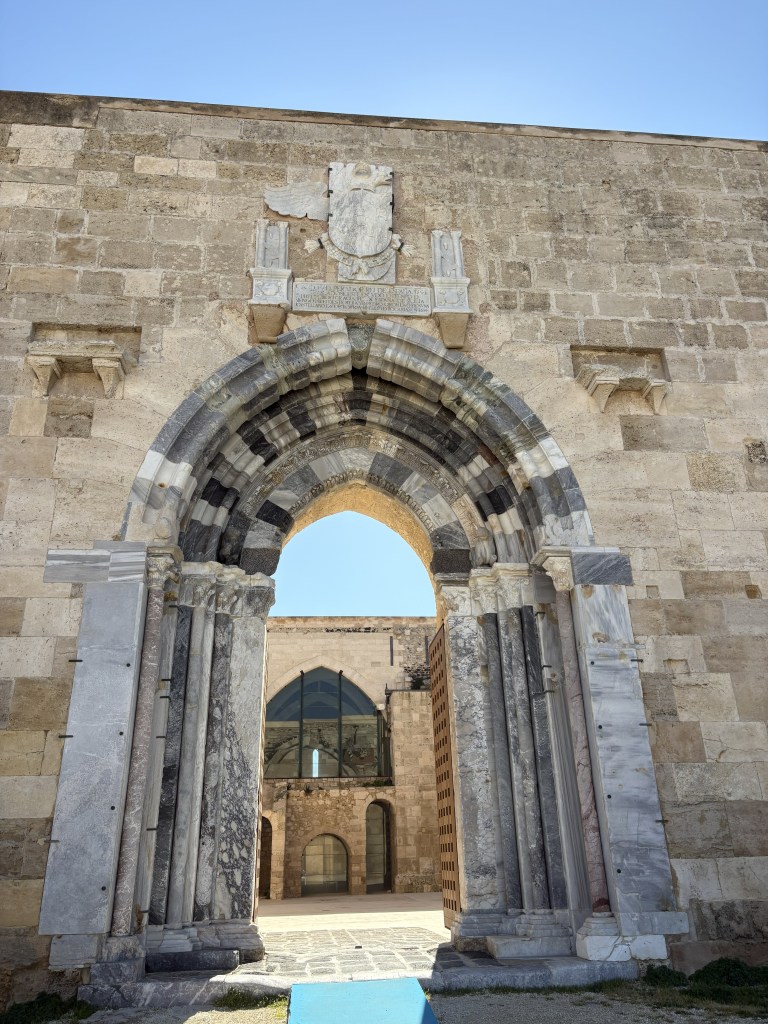
    A part of Maniace Castle in Ortigia, Sicily.

    Maniace Castle/Castello Maniace

    Maniace Castle was a cool, unexpected place during our Ortigia visit.

    We know that Europe has many castles, but we never thought much about seeing them while in Sicily.

    Turns out, right at the tip of Ortigia and on the water, you’ll find Maniace Castle/Castello Maniace.

    The early days of Castello Maniace began as a fort built by the Greeks in 1038. It then was expanded between 1232 and 1240 and was named for George Maniakes, a Byzantine general who took the city in 1038.

    In Sicilian history, someone new was always taking over the region. You can see all of those influences in the architecture of Castello Maniace. Online sites describe it as “Swabian Gothic military architecture,” which reflects a type of Gothic architecture from the Swabia region of Germany. The Swabian dynasty ruled parts of southern Italy in the Middle Ages, hence this unique style.
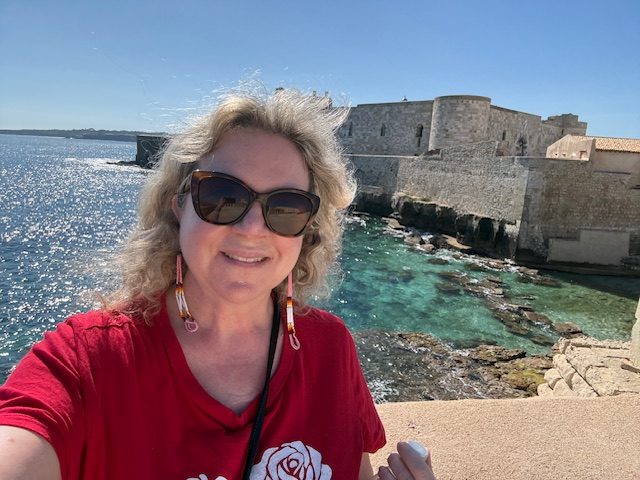
    Enjoying our time near Castello Maniace in Ortigia.

    Yet the castle also has clear Norman and Arabic styles as well, leaving us to feel like we were on an archaeological tour in the Middle East.

    Our time in the castle, which is mostly outdoors, made for a good adventure walk and unique pictures.

    Admission to Castello Maniace is 6 Euros; no cash accepted.

    If you look up info online, don’t confuse Castello Maniace with Castello di Maniace, a manor house located near Mount Etna.

    Here’s a short YouTube video posted by a visitor if you want a preview of what the castle looks like.
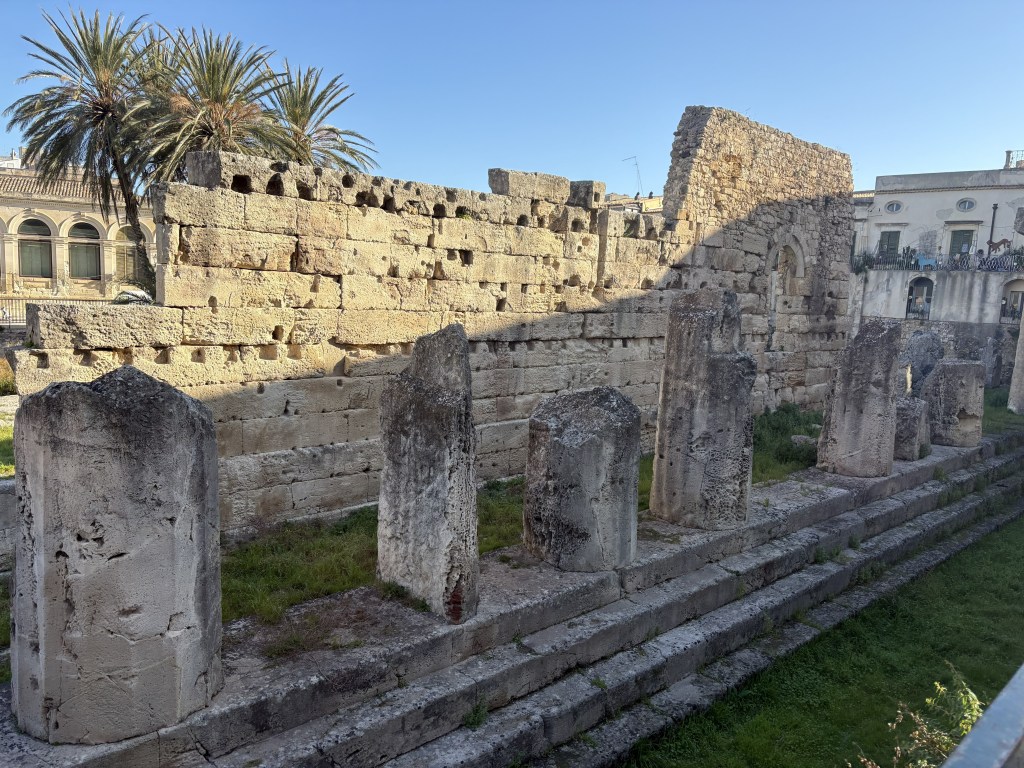
    Temple of Apollo in Ortigia.

    The Greek Ruins/Temple of Apollo

    In Florida, you can’t exactly take a walk and say to someone, “Oh yeah, there are some Greek ruins over there.”

    But you can say that when you’re in Ortigia.

    The ruins date back to 6th century BCE, and they’re located in front of Piazza Piacali, not far from the market.

    The area is fenced off but you can walk the perimeter around the fenced area to fully see the ruins. With the piazza nearby, you could also potentially sit on a bench and contemplate all of the history that’s there.

    Plus, you can see more Greek ruins in the city of Siracusa, including the Greek theatre.
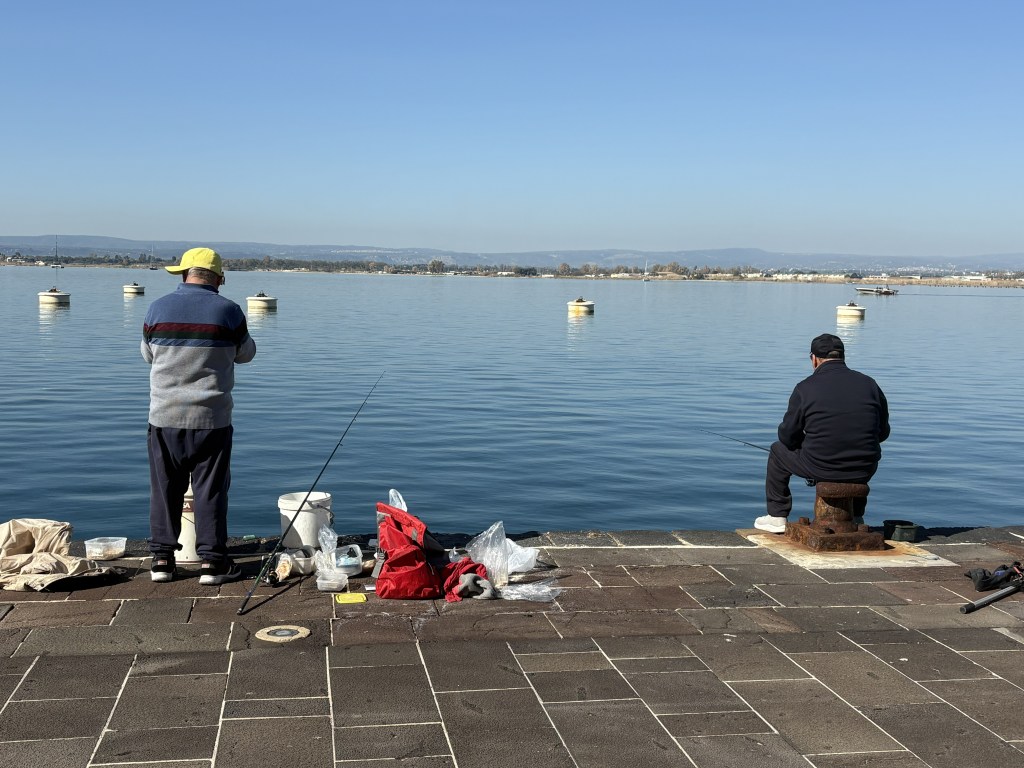
    Locals fishing in Ortigia.

    A One-Day Itinerary for Ortigia

    Now that we’ve outlined some things you can enjoy in Ortigia, we’ll share what we did during our one-day visit.

    After driving through Siracusa morning traffic, we easily found parking toward the right of the island. Some of the most stressful driving of our Sicily trip was in those few morning minutes in Siracusa because there were many cars. We drove in a circle about three times before finally feeling safe enough to make the turn onto the island.

    Just like in the U.S., we paid for parking online using an app.

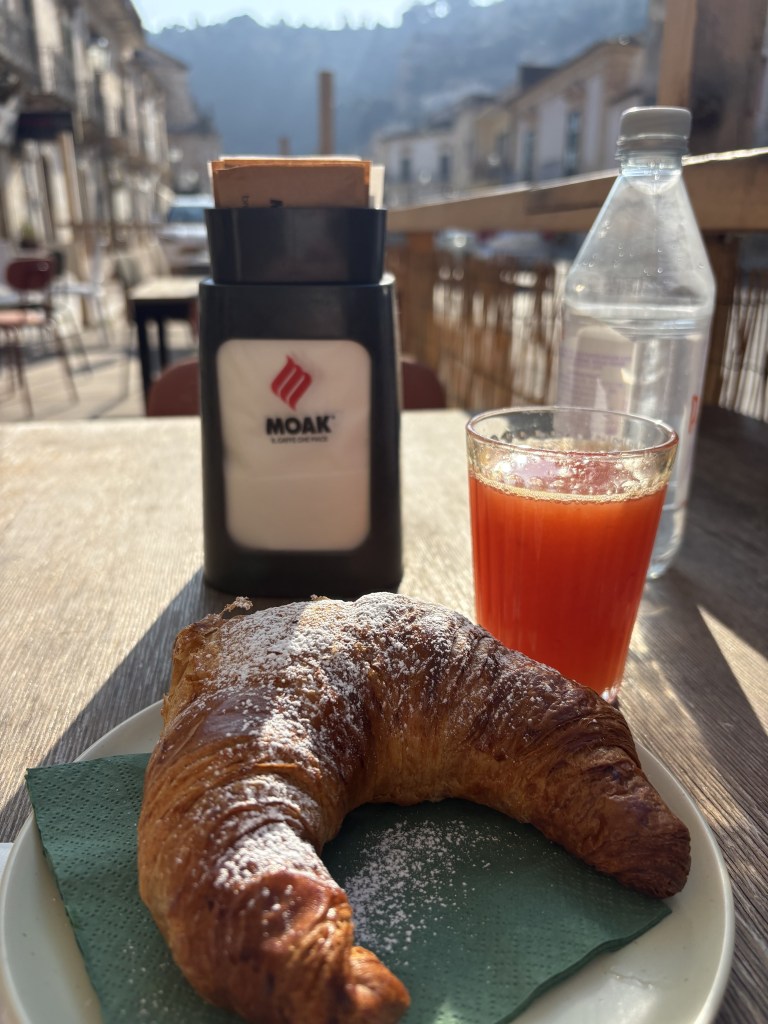
    Next, we used our GPS to walk toward the market but stopped along the way for un cornetto e un succo d’aranchia (croissaint and orange juice), sitting outside in the sun and enjoying a view of nearby cats lounging on chairs.
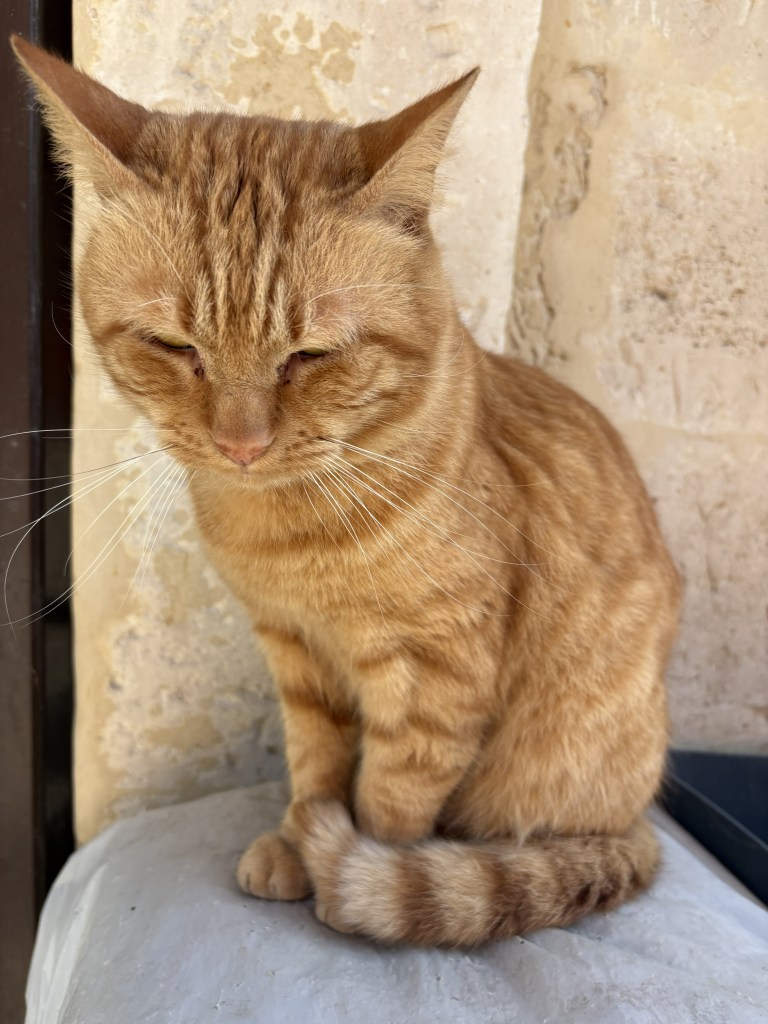
    One of the many kitties we spotted in Ortigia. They were everywhere, it seemed.

    Although the market was open, it was a little early, so we pivoted to check out the Greek ruins and then walk towards the water. This was a great way to get our bearings and see daily life. The water was gorgeous but being late February, we weren’t planning a swim. We also stopped by the cathedral.

    Next we walked a kind of long way to Maniace Castle–see our earlier description. Then we made our way to the beloved market, enjoying many sights, smells, and tastes, including fresh strawberries.

    We meandered between the market and the nearby historical Graziella district, always looking out for another picture to take.

    That led us back to the market, which naturally made us hungry. The restaurants near the market were busy but also the easiest option. We sat down to people watch and ordered a caprese sandwich and an Italian soda and listened to the various customers speaking in English and Italian.
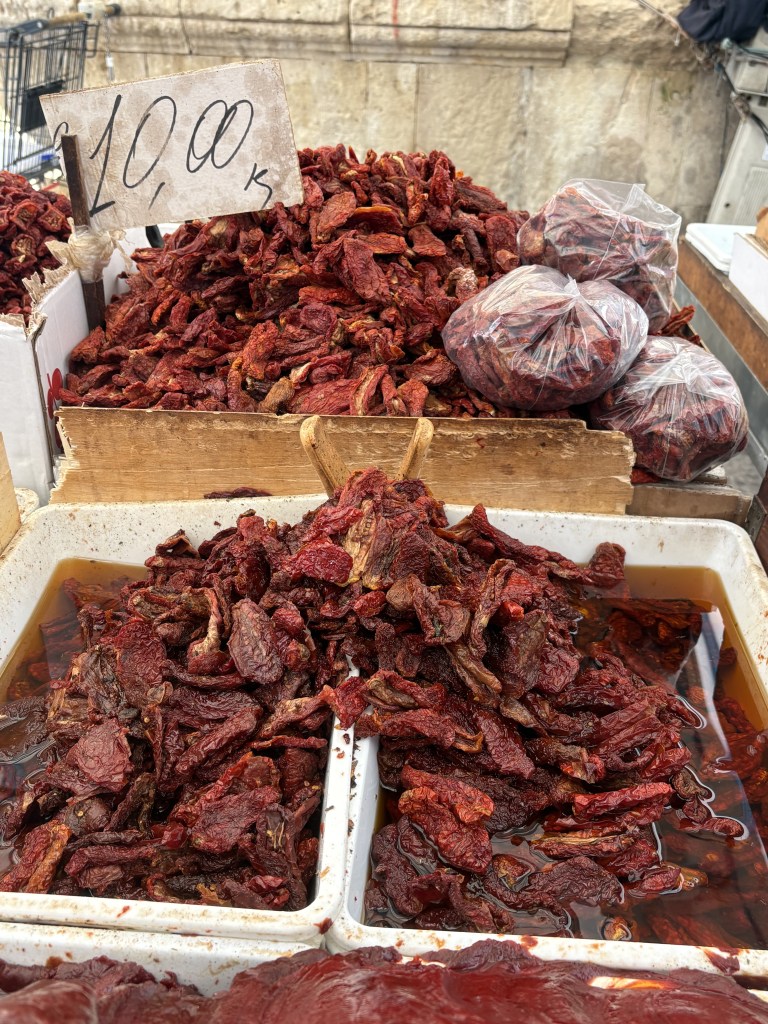
    Sun-dried tomatoes at the market.

    Here’s a summary of our Ortigia one-day itinerary, which you could follow exactly or mix up the order:

    –Grab a small breakfast at a cafe.

    –Walk toward the water for a scenic view, and make sure to stop by the Greek ruins/Temple of Apollo.

    –Visit the cathedral.

    –Visit Maniace Castle.

    –Take your time wandering around the Ortigia Market and the Graziella Fishermen District

    –Get some lunch.
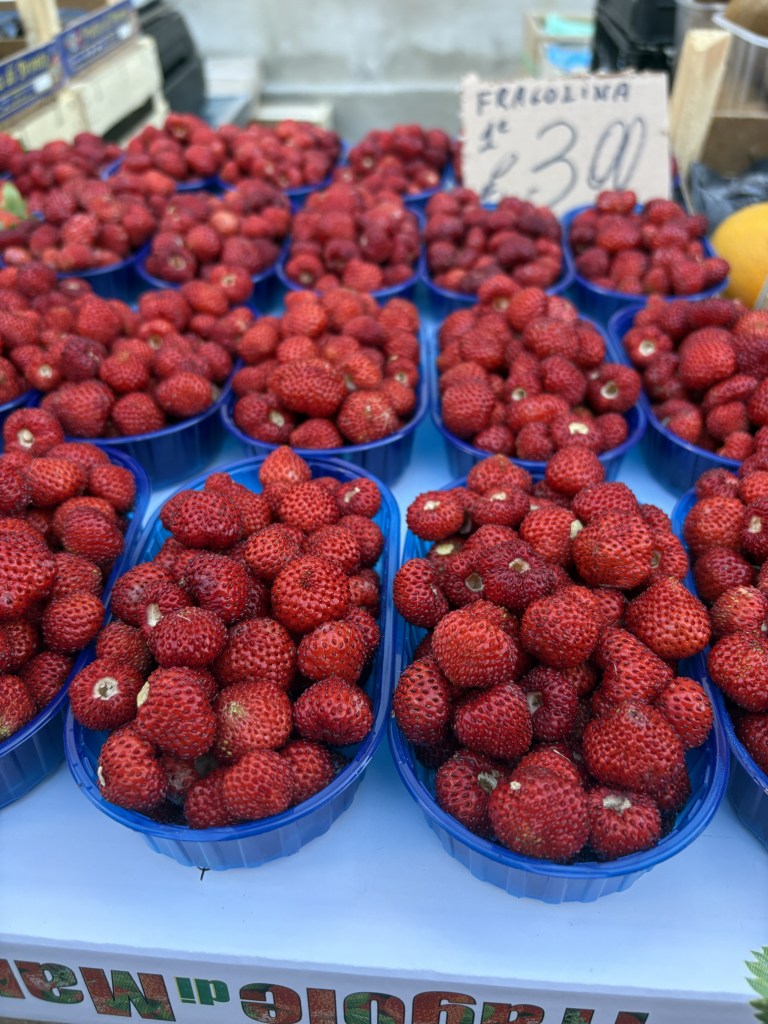
    Buongiorno, fragolina! Good morning, little strawberries!

    A Few Tips for Your Visit to Ortigia, Sicily

    —Consider using Ortigia or Siracusa as your base to explore southeastern Sicily. I stayed in Noto during the trip, and I don’t regret that. It was a great base town. Yet if you’re really keen on getting to know Ortigia/Siracusa, you could stay there instead and explore other nearby cities as you want.

    Siracusa may be better for your stay than Ortigia if you’re renting a car or you want better hotel prices. After all, Ortigia is popular and quite small. Yet if you can find something that suits your budget, go for Ortigia.

    As mentioned, you can do Ortigia in a day trip but if I had more time, I definitely could have turned Ortigia and Siracusa into a three-day exploration.

    —Support the market vendors. Learning about market products is so interesting, and that applies in Italy as well. Even if your Italian is basic or nonexistent, do your best to chat up a couple of vendors and ask for a sample (they may already have samples available) or buy something.

    Our market haul included strawberries, oregano that we’re still using, and a scarf for a family member.
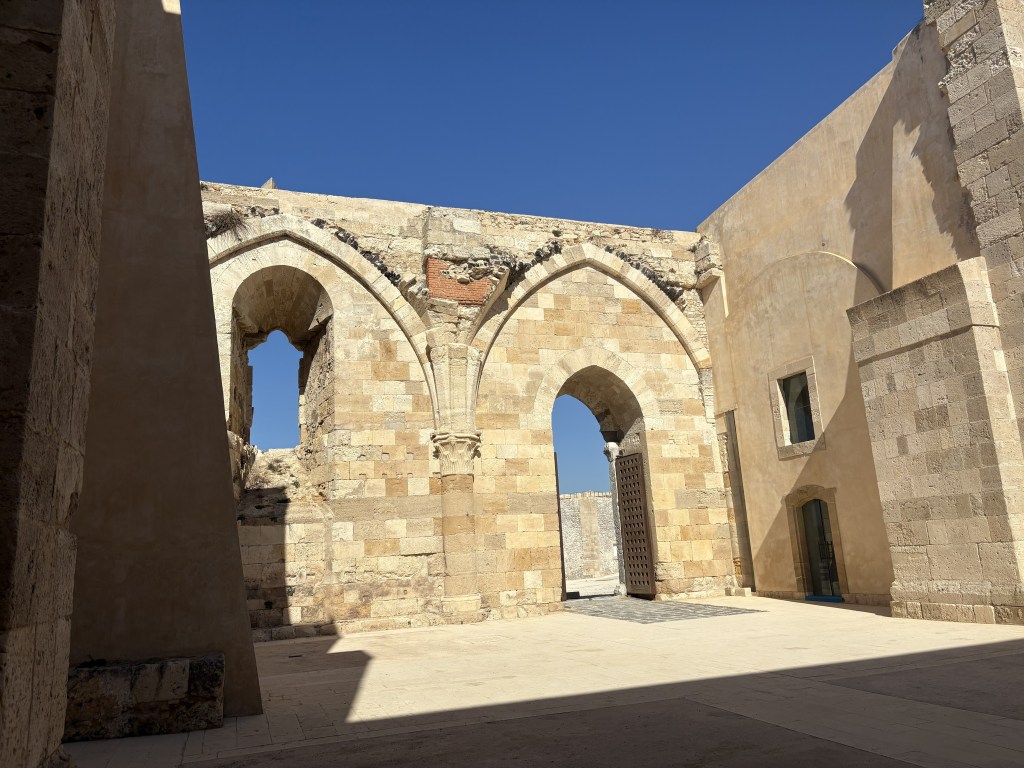
    Another view at Castello Maniace.

    —Wear comfortable shoes. We walked a lot around all of the towns, but we probably did the most walking in Ortigia. That included stairs at several points. Plus, exploring a castle that’s pretty much outdoors may be hard to do in rubber flip-flops.

    —Don’t worry about Mount Etna’s rumbles. We’ve seen people on Sicily social media travel sites fret over their stay in Ortigia and how Mount Etna’s recent eruptions may affect them. Could they affect your flight into or out of Catania airport? Sure. But in terms of your time around Ortigia itself, no, as the two areas are more than 60 miles apart.

    —Explore the restaurants. Although we had the perfunctory sandwich during our lunch, we didn’t get a chance to explore restaurants in Ortigia due to timing. Yet we hear there are lots of fabulous places to eat, so take your time to explore.

    After all, you’re in Italy, AND you’re in Sicily.

    Buon viaggio!
  • 7 Things to Do When You Visit Scicli, Sicily

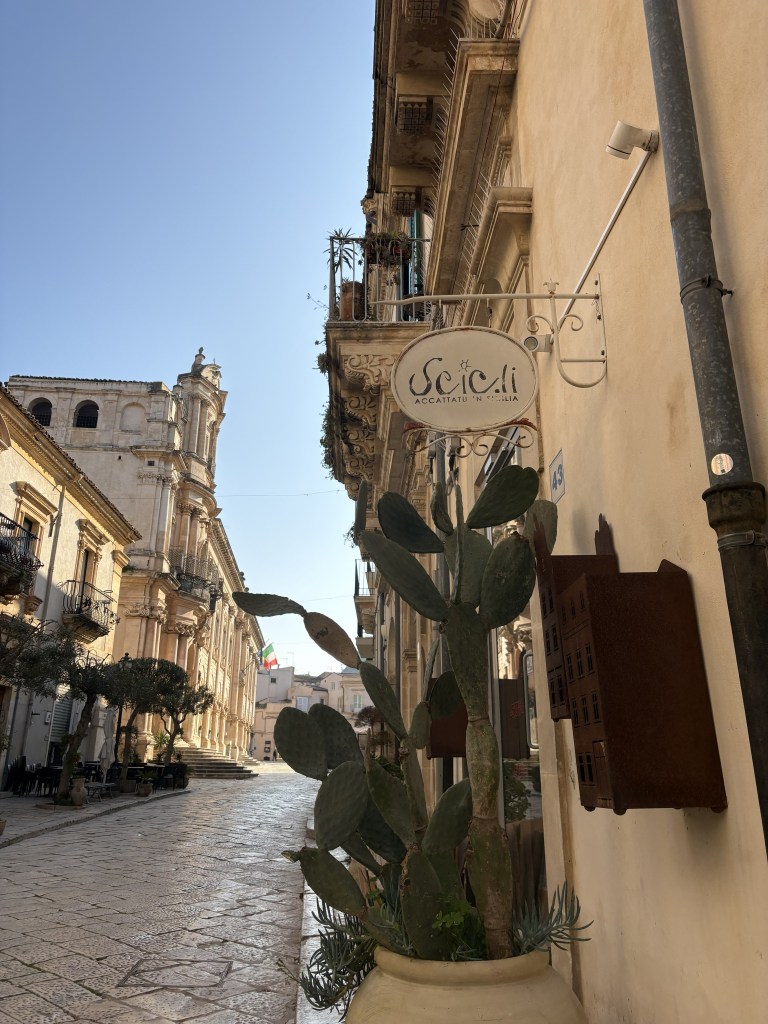
    Scicli, Sicily, Italy.

    Are you thinking about a visit to Scicli, Sicily–or heck, you just want to learn how to pronounce the name correctly? (It’s SHEEK-lee, by the way.)

    Let our article help you.

    Scicli is a charming small town in the Val di Noto in southeastern Sicily, Italy. It’s an ideal day trip if you want a real slice of Sicilian life with some tourism mixed in.

    We wrote an earlier article about Scicli’s A Rutta Ri Ron Carmelu (The Cave Home of Don Carmelo), and we’ll briefly recap A Rutta in this article, too. Yet there’s even more to see and do in Scicli.

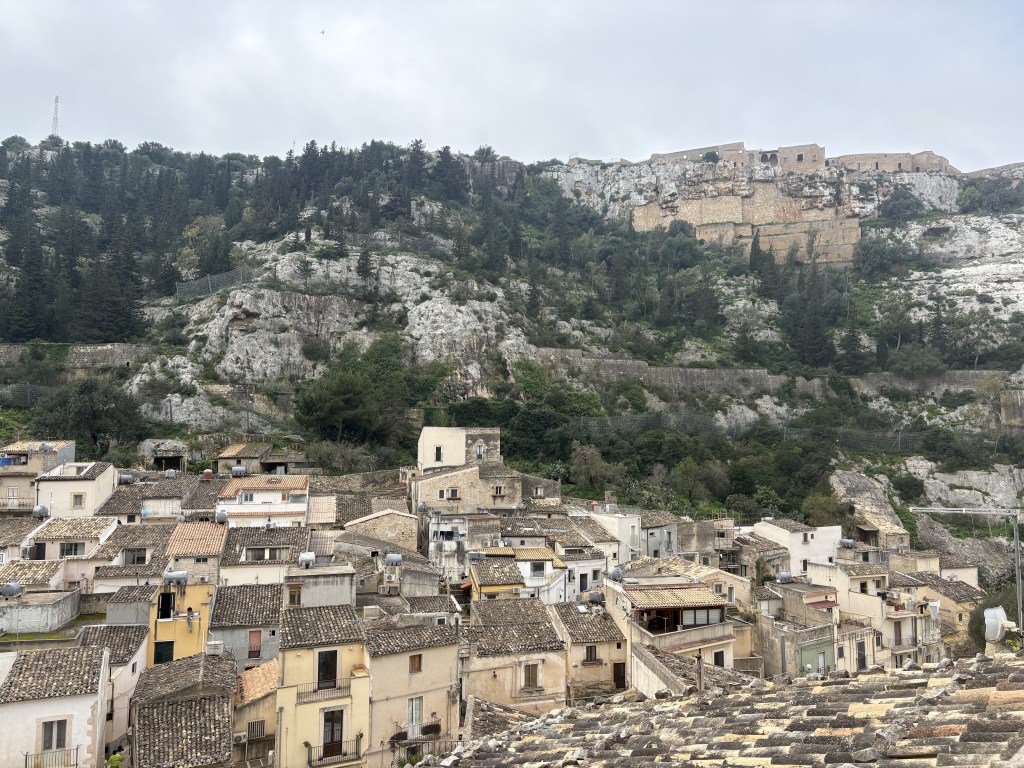
    A view from the hills in Scicli, Sicily.

    Before we dive in further, here are a few fun facts about Scicli:

    –The population of Scicli is about 27,000 people.

    –Scicli is a 40- to 45-minute drive from the popular destination of Noto, Sicily.

    –The town was hit badly by a 1693 earthquake, which also destroyed much of the Val di Noto (Noto Valley). The upside, however, is that the whole area rebuilt itself over the following century in the Sicilian Baroque style that makes Val di Noto so famous today.

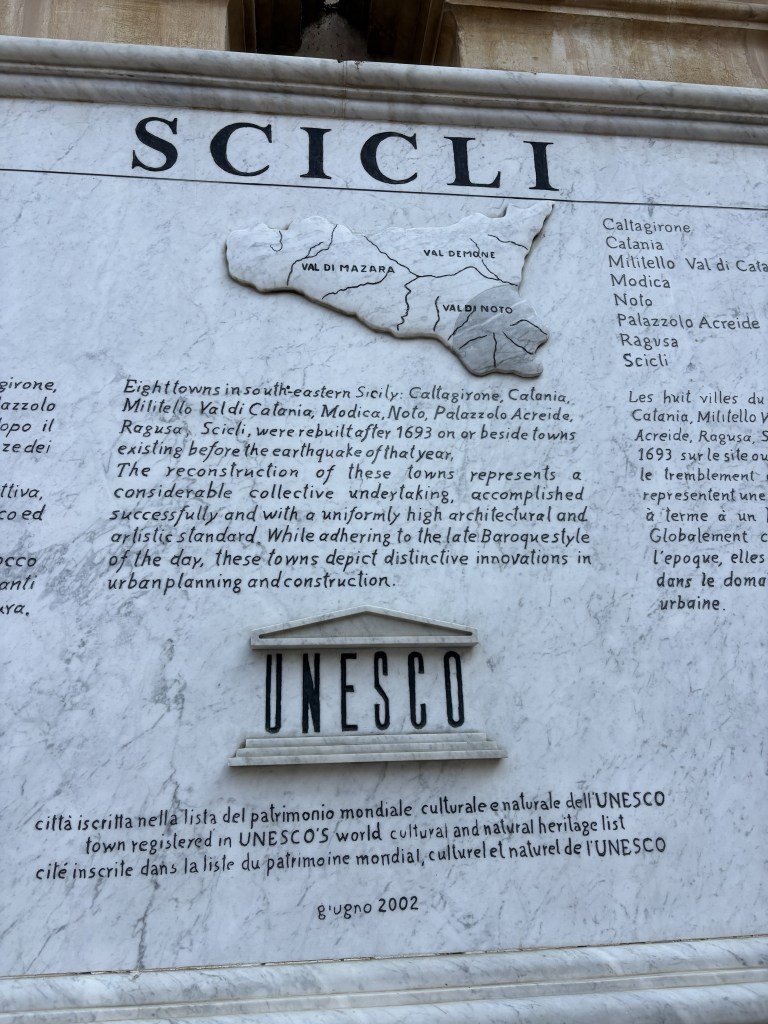
    –It’s one of eight towns in the Val di Noto that’s been named a UNESCO World Heritage Site.

    –Amazingly, the town dates back to the year 300 BCE.

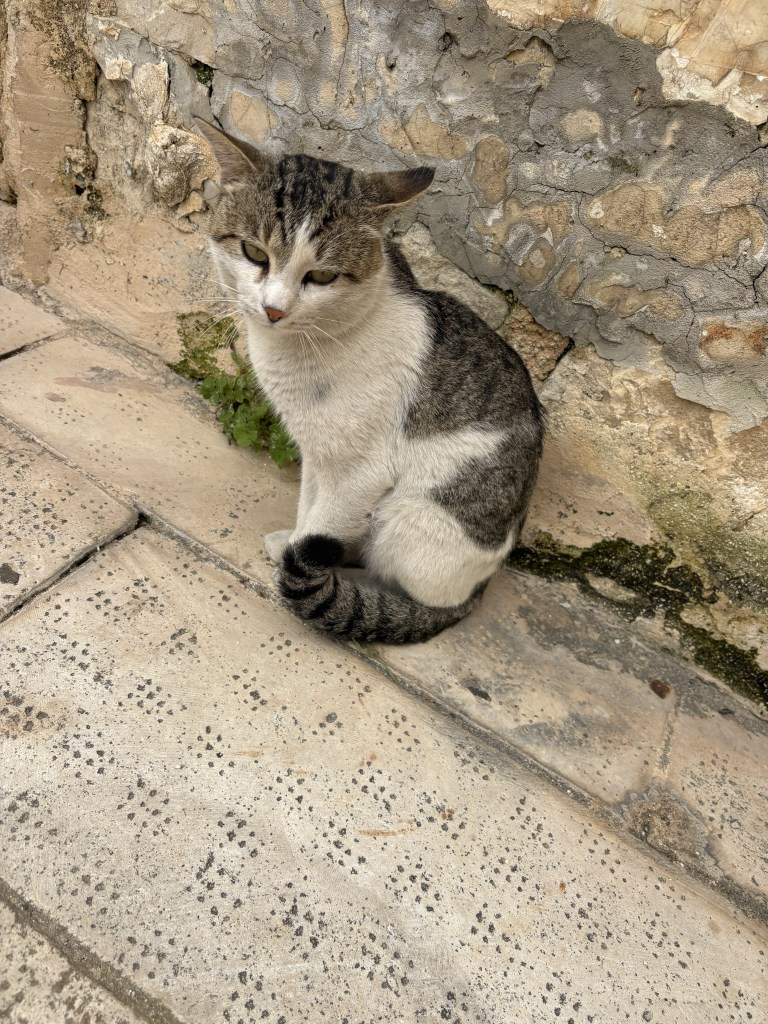
    Un gatto dolce/a sweet cat spotted in Scicli.

    I visited Scicli in early 2026 as part of travels around southeastern Sicily and found it be one of my favorite towns during the trip. It has the same beautiful Baroque architecture as Noto, which is more famous, but the town had a different feel.

    Its rockiness reminded me of the state of West Virginia in the U.S.

    Plus, people seemed….friendlier. I was happy that the people I met in Scicli were a chatty crowd, even with my just-emerging Italian language skills.

    Note that I was traveling solo but sometimes use “we” in my writing just to avoid overusing the pronoun “I”.

    Let’s go to Scicli!

    7 Things to Enjoy in Scicli, Sicily, Italy

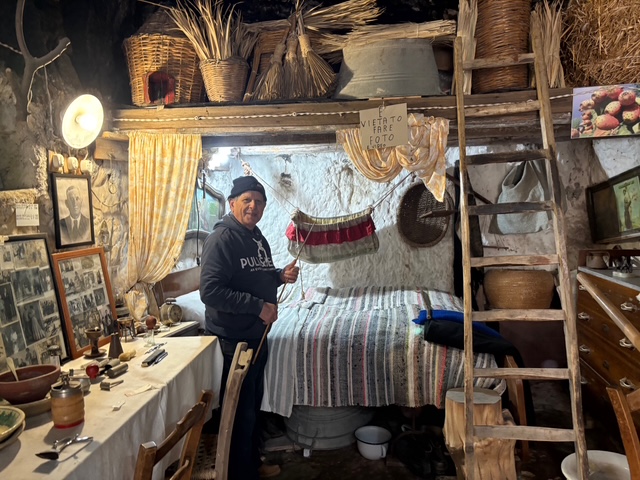
    Mr. Carmelo shows the cave home where his grandparents lived with six children.

    A Rutta Ri Ron Carmelu

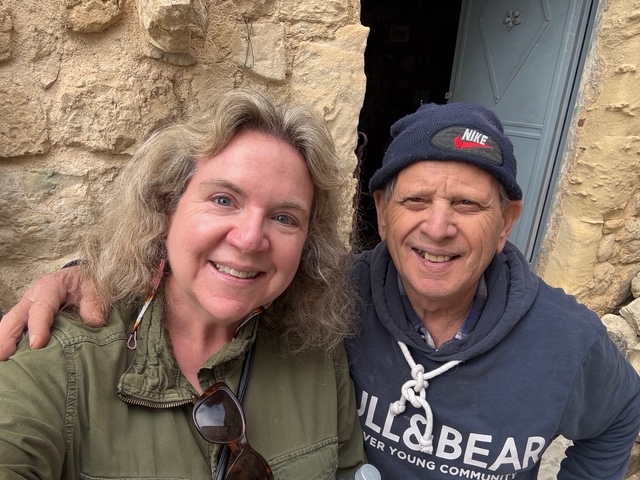
    We covered A Rutta Ri Ron Carmelu in a previous article but to recap this unique attraction: Signore (Mr.) Carmelo gives you a tour of the cave home where his grandparents raised his father and five other siblings. The cave home is set up with all of the “comforts” that came with their crowded cave life.

    After the cave tour, Mr. Carmelo proceeds to show you his many, many creations, from soaps to ceramics to other souvenirs you may want to buy. During our visit, he demonstrates his spinning-top skills with a child-like enthusiasm.

    All of this is done in Italian as Mr. Carmelo doesn’t speak English. Yet somehow, you still understand most of what he shares.

    I’d rank A Rutta Ri Ron Carmelu toward the top of your list for a Scicli visit. Just double check hours in advance to make sure Mr. Carmelo will be available, and be ready for some uphill walking toward the Chiafura cave district. If you have a car, you should be able to drive most of the way there.

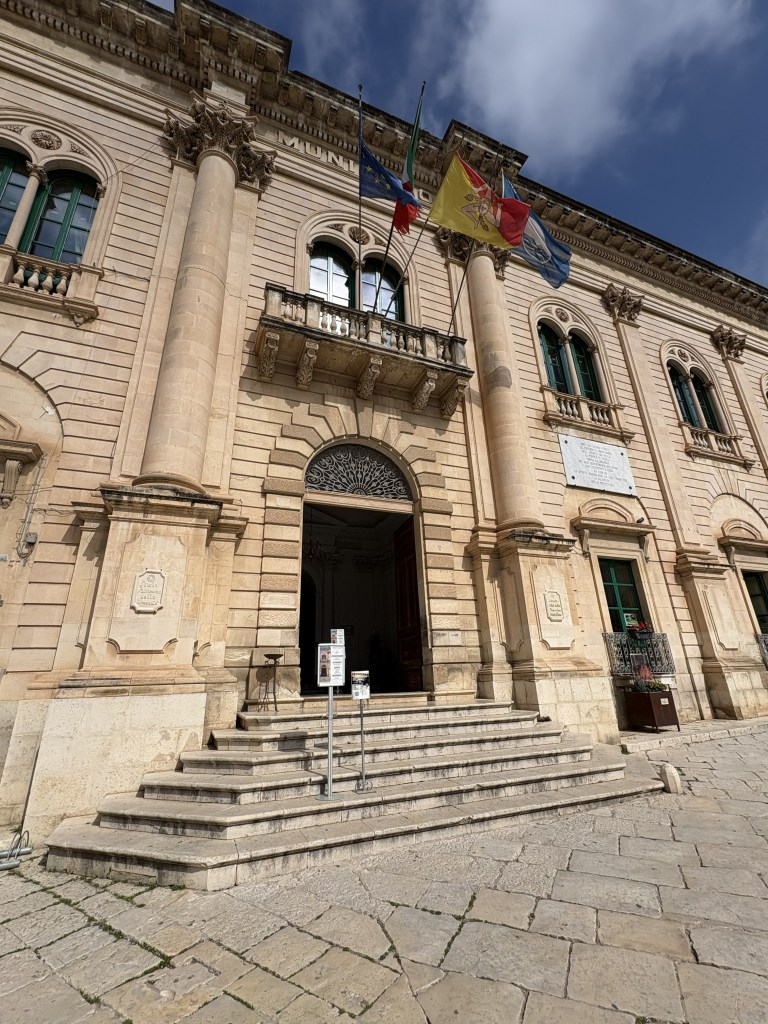
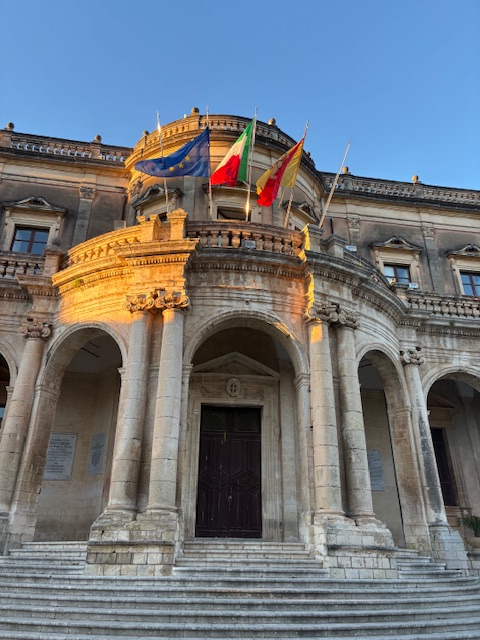
    The Scicli Town Hall entrance seen often on the show “Inspector Montalbano,” which was set in the fictional Sicilian town of Vigata.

    See Places from the Famous Italian Show “Inspector Montalbano”

    As an American newly learning Italian language and culture, I’m a recent fan of “Il Commissario Montalbano”/”Inspector Montalbano”, a detective show set in Sicily that became a hit all around Italy.

    I subscribe to MHZ TV through Amazon Prime to watch the series and the subsequent show, “Il Giovane Montalbano”/”Young Montalbano.”

    “Inspector Montalbano” reached as many as 11.3 million viewers for an episode in 2017 and 1 billion viewers cumulatively during all of its 37 episodes, which spanned from 1999 to 2021. Each show is like a film, lasting almost two hours. The same is true of “Il Giovane Montalbano.”

    Actor Luca Zingaretti plays the grumpy, seafood- and sea-loving inspector in the main show, and Michele Riondino plays the younger version of the inspector.

    The show is based on a series of books by the late Sicilian author Andrea Camilleri that he began to publish at age 70. The books were in Italian but sprinkled with the Sicilian dialect, and the same is true of the show.

    With my interest in Italian language and Sicilian scenery (because clearly I have a past life connection to Sicily, LOL), the two Montalbano shows have become fun weekend watching.

    The shows are set in a fictional Sicilian town called Vigata, located in a fictional province called Montelusa.

    Here’s the Scicli connection: Scenes from “Inspector Montalbano” were filmed around southeastern Sicily, and the fictional police station is Scicli’s actual town hall. It’s seen a lot in the show.

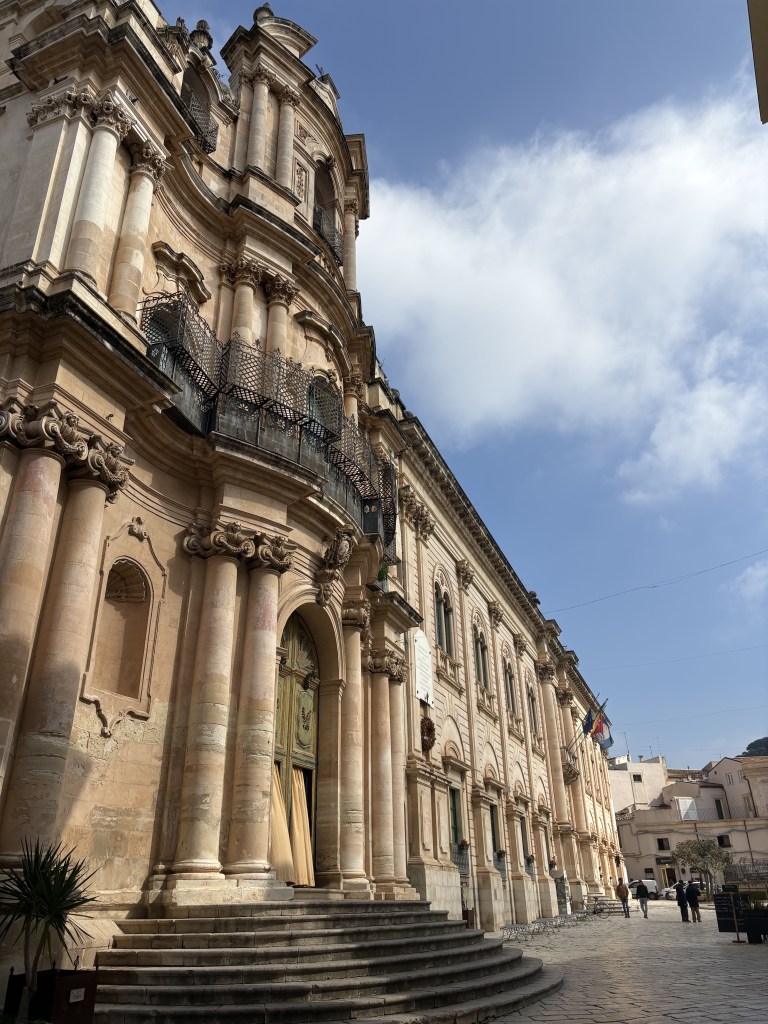
    Another view of Scicli’s town hall.

    I saw the exterior of the town hall when I visited Scicli and snapped a few pics. Sadly, I hadn’t yet watched the show so I didn’t have the foresight to go inside and see the fictional set-up the town hall still has in honor of Montalbano. Next time!

    Even if you don’t know the show, it’s worth a look if you want to appreciate something from Italian/Sicilian pop culture.

    If you are indeed a Montalbano fan, there are day tours you can take to see various sites from the filming of the show.

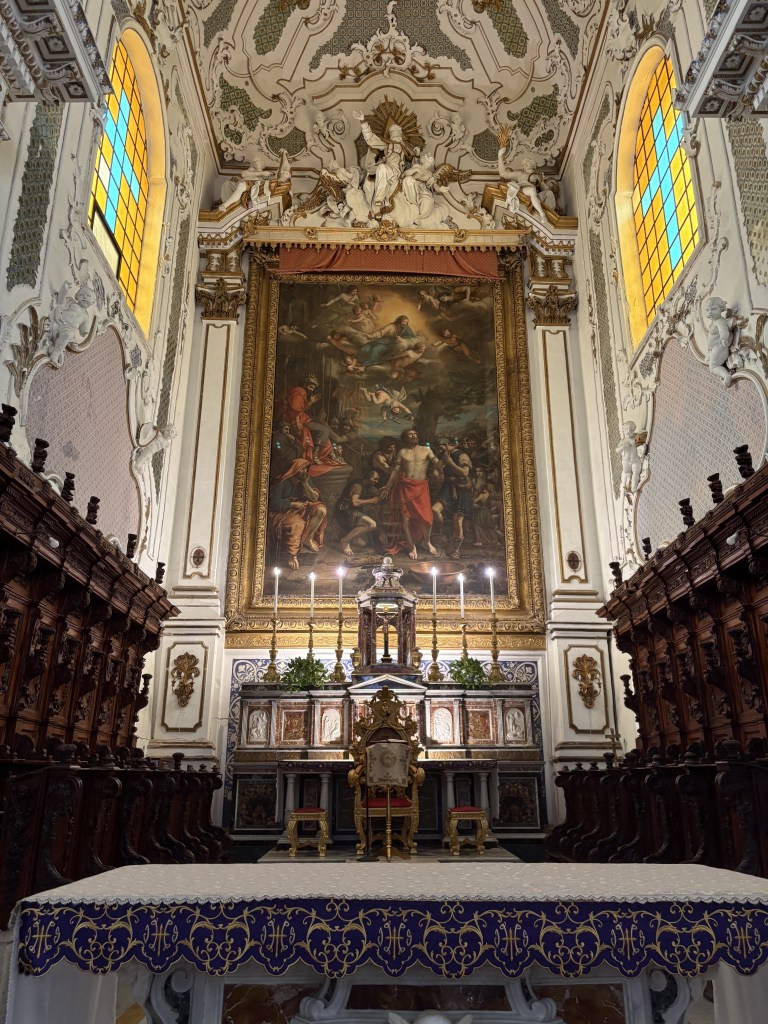
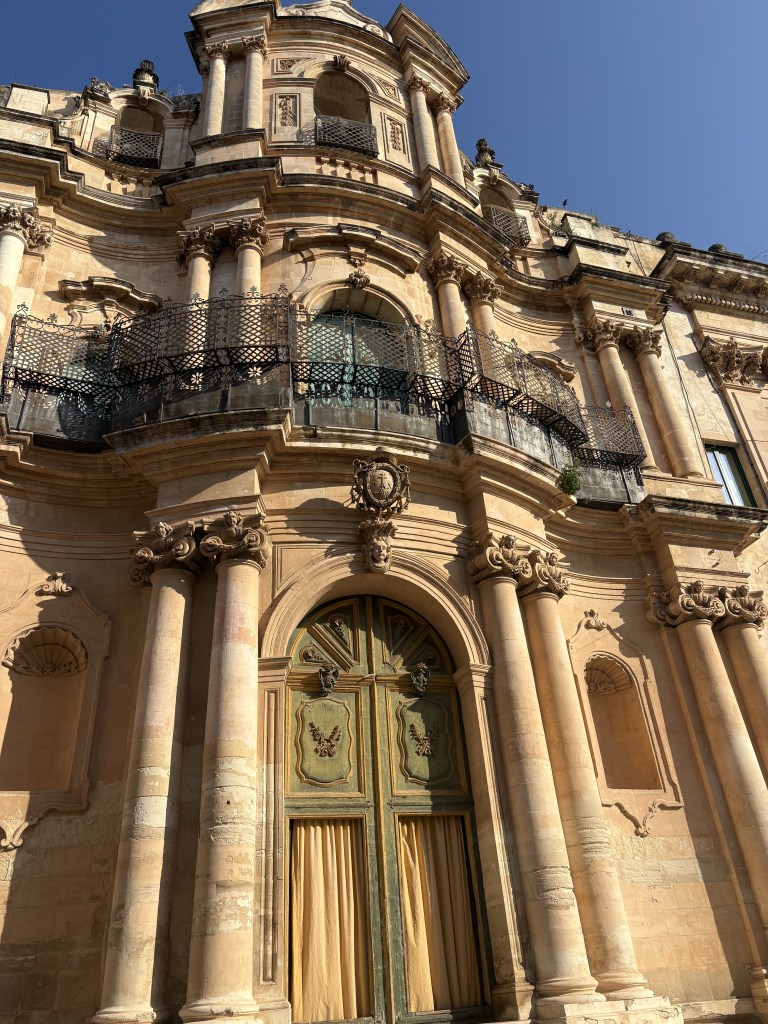
    Inside the beautiful Church of San Bartolomeo in Scicli.

    Enjoy Baroque Architecture and Churches

    As stated earlier, Scicli is one of eight towns in the Val di Noto famous for its beautiful Baroque architecture.

    Some of the Baroque highlights in Scicli include:

    —Church of San Bartolomeo (not far from La Rutta Ri Ron Carmelu), a quiet wonder during our short visit

    –Palazzo Beneventano

    –Church of San Matteo

    –Church of Santa Maria La Nova

    You’ll find other examples, including some sites that occasionally appear on the Montalbano shows.

    The more well-known Baroque examples often have signs beside them in Italian and English to help you better understand their history and significance.

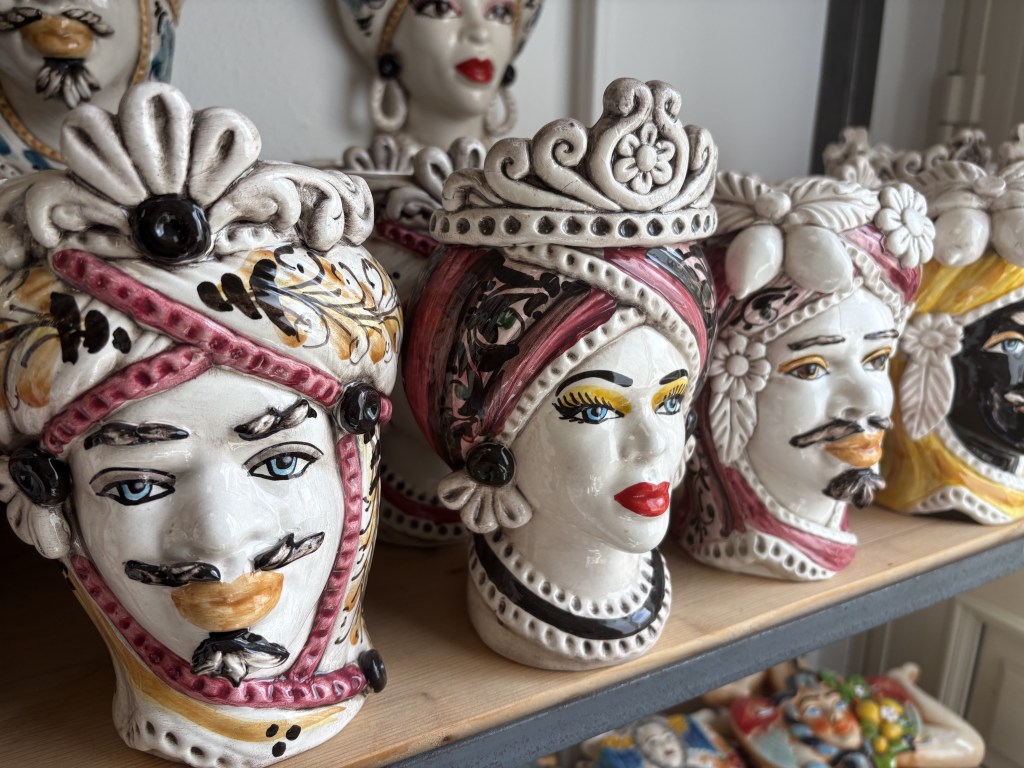
    The famous Teste di Moro (Moor’s Heads) statues, seen here in Scicli.

    Eat and Shop, Shop and Eat

    If you’re anywhere in Italy, you gotta eat, right?

    If you’re in Sicily, famous for So.Much.Good.Food., this rule applies double.

    Why not enjoy some of that famous food in Scicli?

    We only grabbed breakfast while there, so we don’t have any Italy Dreams-approved restaurants to recommend.

    However, folks online praise places like Baqqala, My Name Is Tannino and Prosit Sicilian Bistrot. If you’re looking for dessert, remember that gelato is calorie-free while you’re in Italy. 🙂

    As for shopping, we made our way to several souvenir shops in Scicli, some of the higher-end variety with beautiful handmade items and others a little more generic. We had already purchased a small black vase at A Rutta Ri Ron Carmelu, so we didn’t make another purchase beyond some olive oil.

    Yet we appreciated that shop workers were friendlier…not that they were unfriendly in other towns we visited. Perhaps in Scicli, they appreciated the business as it was still off-season.

    Our croissaint and orange juice in Scicli.

    Absorb Daily Life in Scicli

    There was something about Scicli that made it easier to get a sense of daily life there.

    There was the encounter we had with a local female police officer who got annoyed that we initially parked in the lot for the train station/police office (oops!).

    There was the young couple arguing near the Church of San Bartolomeo, seemingly unaware of others listening.

    There was the shopkeeper who swapped stories with me about his dog, after I pointed out (in Italian!) that a picture he had in the shop looked like my own dog.

    There was the aforementioned encounter with Mr. Carmelo, who’s a real character.

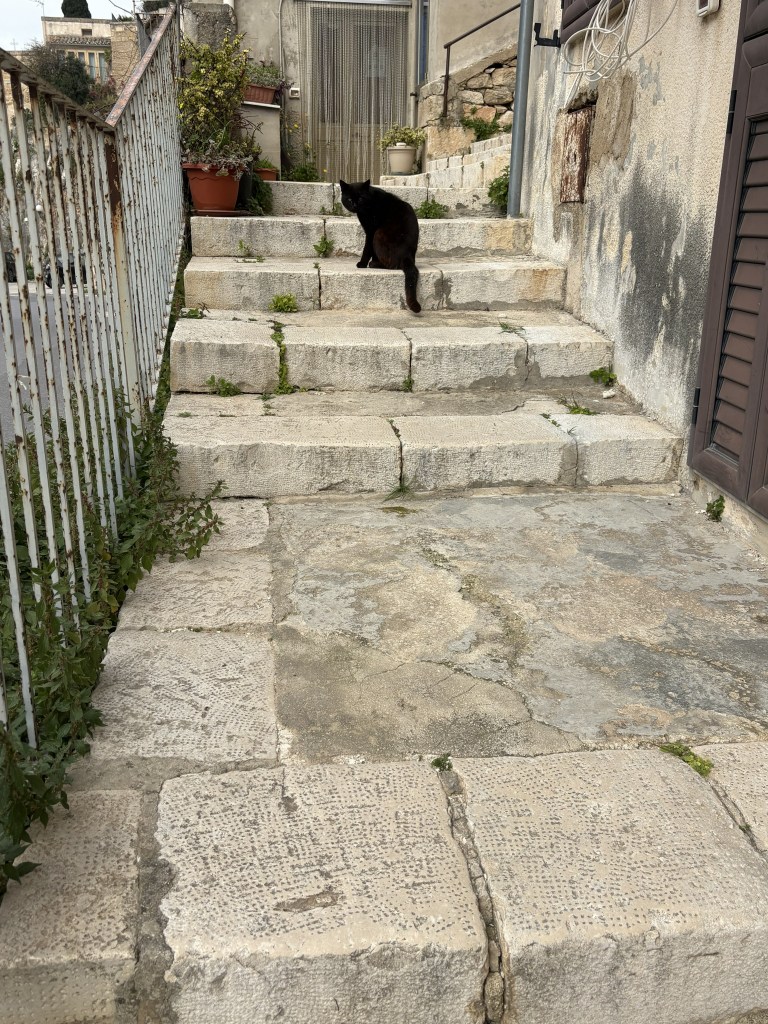
    A black cat spotted in the Chiafura cave district in Scicli.

    There was the time spent in a small but maze-like supermarket where we compared prices for pasta, bread, produce and other items against our U.S. prices.

    Could you have these types of encounters in another southeastern Sicilian town? Sure. Yet there was something in Scicli that made them more accessible, friendly, and easier to observe.

    You can also find that kind of life interaction in Catania, for example, but there’s so much happening at once there, I found it harder to take in. That’s why Scicli was perhaps more appealing.

    Enjoy Nearby Beaches

    As we visited Scicli in the winter, we never made it to nearby beaches. Yet even with the hill-like feel of Scicli, you’re not too far from a dip in the sea on beaches like:

    –Spiaggia di Sampieri

    –Spiaggia di Mannara

    –Spiaggia Pantano Arizza

    Double check online or with locals about these or other beaches before you visit.

    If you’re driving back towards Noto or Marzamemi, you have many other coastal options, including San Lorenzo or the beaches at Vendicari Nature Reserve.

    And in case you were wondering: There are beach scenes from “Inspector Montalbano” filmed in Punta Secca, east of the beach destinations mentioned here.

    A morning view in Noto, Sicily.

    Visit Other Nearby Baroque Towns

    Whether you’re staying in Scicli during your time in southeastern Sicily or visiting for a day trip, you can absolutely take the time to take day trips to other nearby towns. This will be easier to do if you rent a car or hire a driver.

    As mentioned before, there are eight towns in the Val di Noto that are considered UNESCO World Heritage sites for their Baroque architecture. They include:

    –Caltagirone

    –Militello Val di Catania

    –Catania

    –Modica

    –Noto

    –Palazzolo

    –Ragusa

    They’re all relatively close to each other (Catania’s a bigger city, of course). Between our experience and that of others, we favor Modica, Noto, and Ragusa.

    Although it’s not a Baroque area, we enjoyed nearby Marzamemi as well.

    Drive safe–here are our lessons from driving around Sicily–and enjoy your visit to Scicli and the surrounding area.

    Buon viaggio!
    Some more information about the UNESCO towns in Val di Noto.

  • Mount Etna Volcano, the Fish Market, and More: Here’s What to Know Before You Visit Catania, Sicily

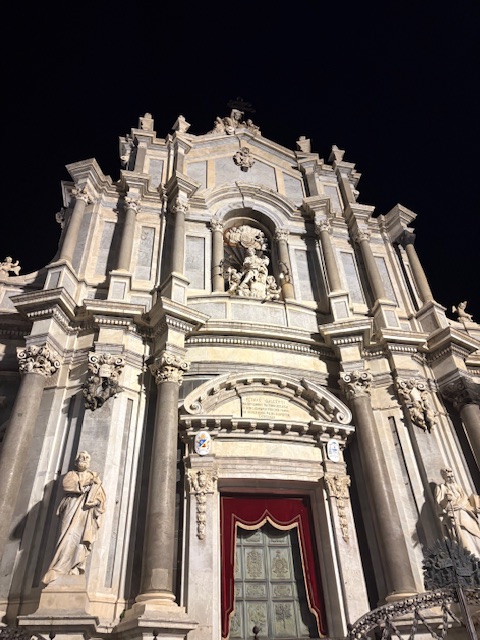
    Saint Agatha Cathedral in Catania, Sicily. Saint Agatha is the patron saint of the city.

    If you’re planning a visit to Sicily, Italy, and you’re wondering if you should visit Catania, located in eastern Sicily and the second largest city on the island, here’s our simple answer:

    If you’re flying in or out of Sicily via the Catania airport, stay a night or two there so you can check out some of its highlights. If you like vibrant city life, spend some time there.

    It’s not going to be the peaceful experience you’ll have in smaller Sicily towns, but Catania definitely has history, passion, tasty food, and cool views of Mount Etna volcano.

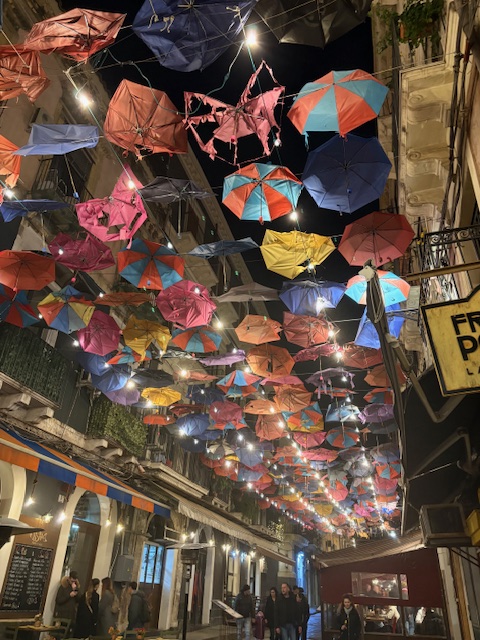
    Umbrellas decorate the view in one part of Catania’s city center.

    Let me walk you through my two nights in Catania and share a few tips that may help you. I stayed there in late February when it was off-season in Italy.

    A quick note: I was traveling solo as a female but sometimes use “we” in my article to avoid using “I” all of the time.

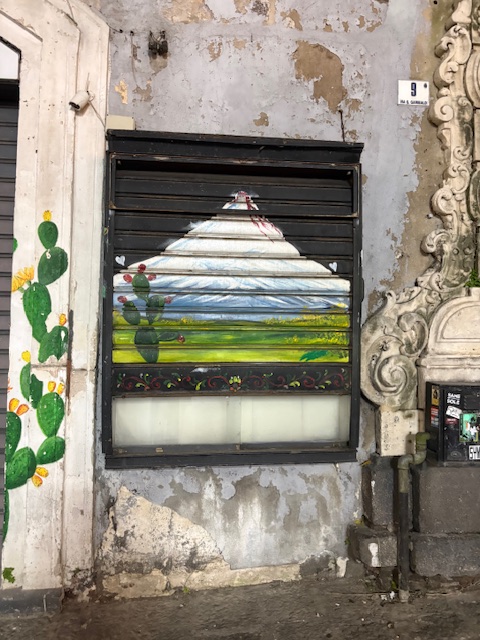
    A street painting of Mount Etna. The view of the real thing is even more impressive.

    Some Quick Facts About Catania, Sicily

    Before sharing visit details, let’s load you up with a few facts about Catania, so you can put your visit in context:

    —The city has about 315,000 residents, and there are about a million people in the general area. The city also has beaches although we didn’t make it to them. The beach areas received some damage during Cyclone Harry in January 2026.

    —Catania got hit by a bad earthquake in 1693 and was rebuilt in a Baroque style using black lava stone from the famous Mount Etna volcano. This earned Catania its nickname of “the Black City.”

    —The historic city center of Catania is a UNESCO World Heritage site.

    —Catania’s been around for a loooonnnng time–since 8th century BC.

    —Catania has an underground city that you can tour. It features Roman-era aqueducts and more.

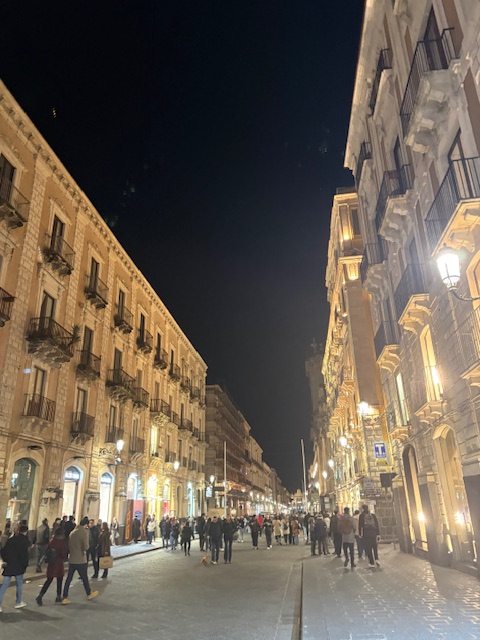
    A view of Via Etnea, a well-traveled street in downtown Catania, Sicily.

    Sights to See in Catania, Sicily…and the Scoop on Staying There

    OK, let’s get to it! I arrived in Catania on a Saturday evening, tired from my trip (I flew from the U.S. to Rome and then Rome to Catania) but also eager to explore the city. Pretty quickly, it reminded me of Lima, Peru, which I’ve visited a few times. Beautiful architecture with some gritty city life around it. Not gritty as in unsafe or ugly, just….a lot going on. Definitely a city with stories to tell.

    The four-room B&B where I stayed (shout out to Opera Boutique) was located on a hill about a block or so from Via Etnea, the popular pedestrian-friendly street filled with cafes and shops. After getting settled, I quickly made a beeline toward Via Etnea and watched my step heading down the steep decline.

    Right away, the rush of city life and energy was there. Young people–or mostly young, especially compared to the people I saw in SIcily’s smaller towns–were all around, dressed in black and flirting with each other, vaping, sometimes arguing. Street performers did what they could to attract passerby and get a few Euros tossed their way. Servers from restaurants beckoned passerby to try the pasta, pizza, or drinks at their place.

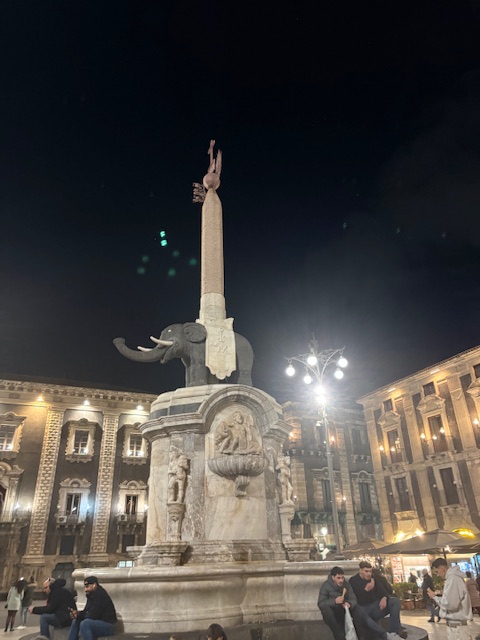
    Catania’s famous elephant statue, nicknamed u Liotru in Sicilian.

    I strolled for awhile before deciding where to eat, taking in the crowd but also the view of Saint Agatha Cathedral (closed for the evening) and the famous elephant statue called u Liotru that symbolizes Catania–located right across from Saint Agatha. It’s a good stopping point, but it also was crowded on Saturday night.

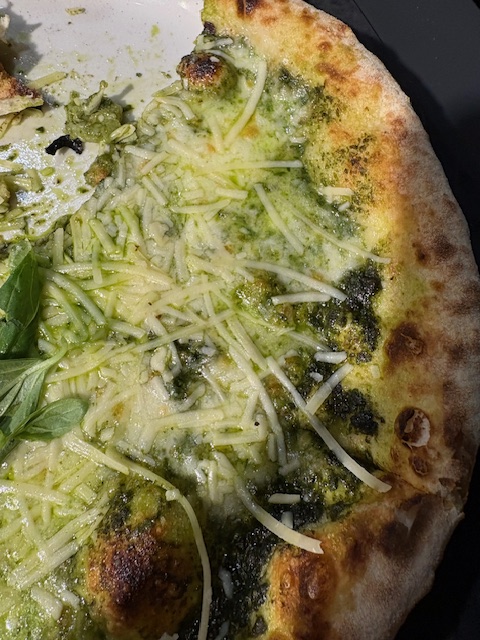
    Pesto pizza in Catania. It was as tasty as it looks.

    I eventually stopped for pesto pizza (delizioso) and a bright orange aperol spritz. OK, two of them.

    After getting a little lost, I eventually made it back to my B&B. While my phone’s GPS was helpful overall during my Sicily trip, it sometimes got things wrong and sent me on a goose chase that evening. I recommend that you have a backup plan for situations like that, whether it means paying attention to where you’re going as if you didn’t have GPS or keeping your phone charged well. Also, take a screenshot of where you’re staying and its address.

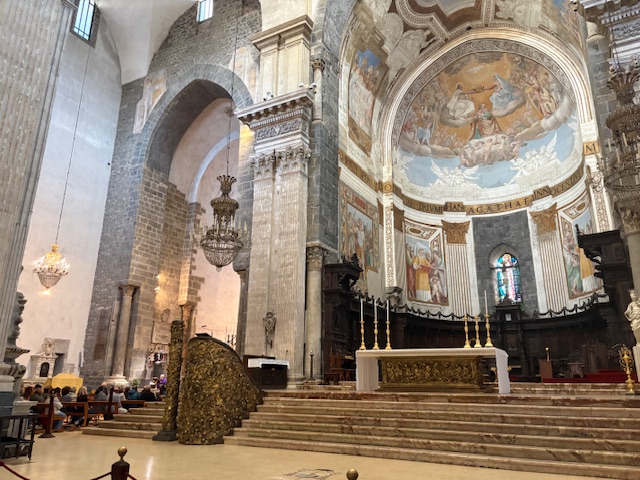
    Inside Saint Agatha Cathedral.

    The next morning, I enjoyed Via Etnea with far fewer people and far-off views of beautiful Mount Etna. I was able to go inside Saint Agata Cathedral (called Cattedrale di Sant’Agata or Basilica Cattedrale Sant’Agata in Italian) and learned a little more about its history. It was originally built in 1078 but then was almost completely lost by an earthquake in 1169 and then another earthquake in 1693. It was rebuilt in its current Baroque style and is now a UNESCO World Heritage site.

    Another view in Saint Agatha Cathedral. It’s kind of hard to see, but there was a small service going on toward the left.

    The cathedral honors Saint Agatha of Sicily who lived in the third century. Saint Agatha is the patron saint of Catania and of breast cancer patients. It’s also said that she helps to protect the city against volcanic eruptions. There’s a massive festival to celebrate Saint Agatha that’s held in early February in Catania. I was there just a couple of weeks after the festival.

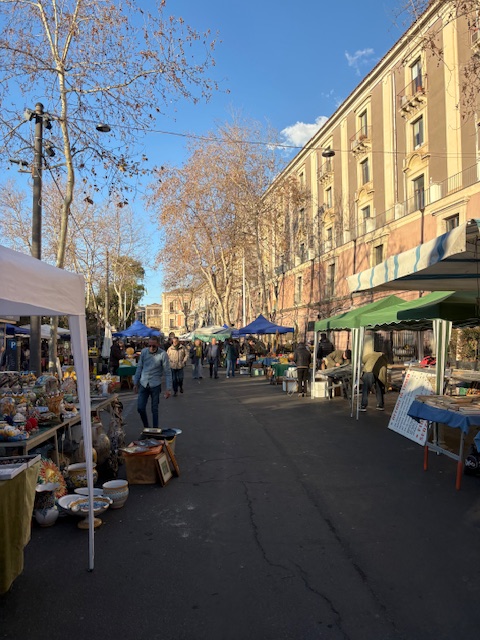
    A Sicilian Sunday morning flea market.

    I came across a flea market in the same area where the fish market is held Monday to Saturday (more about that below). As a lover of outdoor markets here in Florida, it was great to compare flea markets in the Sunshine State versus Sicily, especially one I didn’t expect to encounter. As it turns out, flea markets still give you a great sense of the local culture, with old albums, vases, books, ceramic plates, and other items that were (mostly) unique to Sicily.

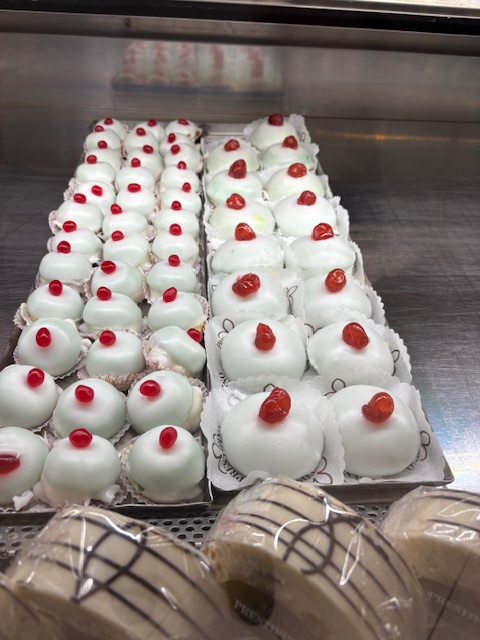
    Sicily is well-known for its desserts. We spotted these Minne di Sant’Agata at Prestpino Cafe in Catania.

    I enjoyed breakfast at Prestipino Cafe, where I ordered un espresso e un cornetto, per favore (an espresso and a croissant, please), along with a fresh-squeezed orange juice. Sicily is known for its citrus fruits. Everything was delicious, but the chocolate filling in my croissant got messy and I noticed a family of tourists gently laughing at my mess. Oops!

    I took several pics inside Prestipino of the traditional Sicily desserts they had on display, giving me a sneak preview of things I’d try later in my trip.

    I eventually made it back to the B&B and took an Uber to get my rental car. Since I’m focusing here on Catania, I’ll skip the rest of my trip (although you can read about it here) and jump ahead to my second night in Catania–the last night of my trip before returning home.

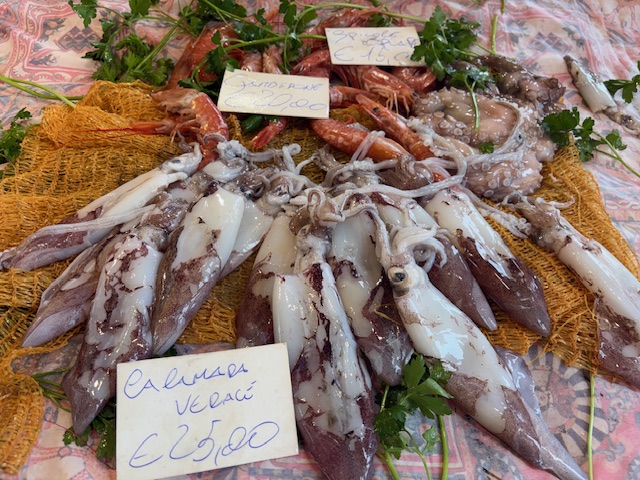
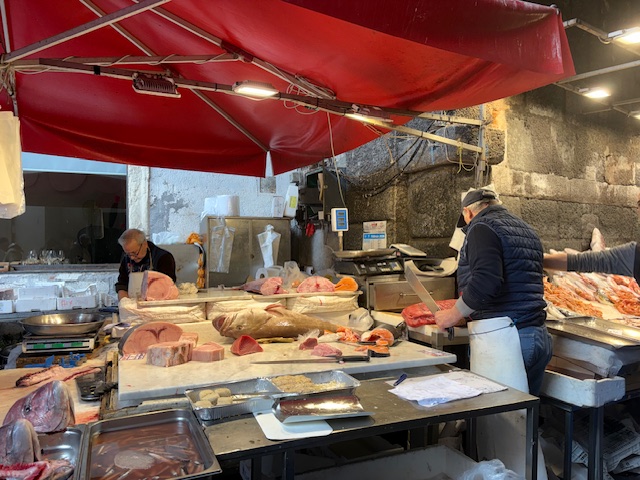
    My return to Catania got me into the city around 12:30 in the afternoon, where the B&B hostess let me know if I wanted to make it to the Saturday fish market, I’d have to hustle. I did just that and again, as a perennial fan of outdoors markets, it didn’t disappoint. There were so many types of fish around. While I wasn’t looking to buy any to cook, they were still great to see for pictures and the atmosphere.

    Calamari for sale at the Catania Fish Market.

    Much like my previous Saturday in Catania, the city was bustling and there were even more tourists than before. In addition to the fast-moving feel of the fish market, restaurants were doing a brisk business and I saw signs for horse meat (carne di cavallo), which is famous in Catania and a few other parts of Italy.

    The fish market was a definitely a highlight of my time in Catania.

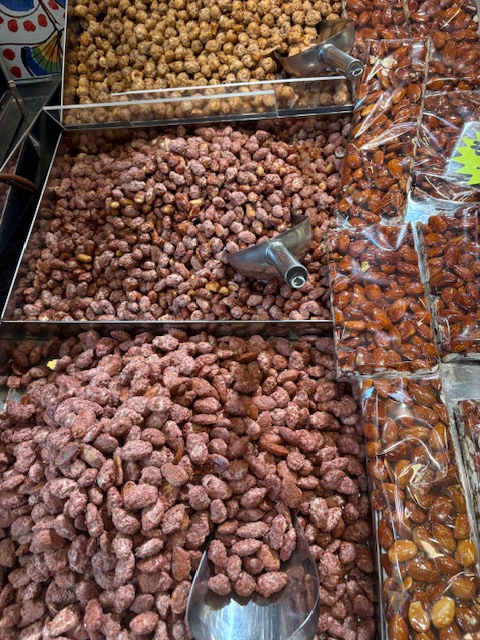
    Ultimately, my need for sweets prevailed and I purchased some praline-style almonds from a street vendor–almonds are yet another agricultural item well grown in Sicily. This may not have been a balanced lunch but they were just what I wanted. We’ve all had those days, right?

    Yummy nuts in Catania make for a good street-food snack.

    The street area was quite busy (and honestly, smoky from people who smoke/vape). Beyond a pizza for dinner, those were the highlights of that day in Catania.

    I made it to the airport early the next morning with some confusion as a few of us thought our ticket counter hadn’t yet opened, only to realize it was open in a different part of the terminal. There’s sometimes confusion like that in Sicily, so make sure to advocate for yourself when something is unclear during your visit. Knowing some basic Italian can help.

    If I were to return to Catania, I would make time for at least a half-day tour of Mount Etna (elevation: 11,000 feet). It’s one of the oldest and most active volcanoes in Europe, located in Etna National Park. Although I was traveling through Sicily independently, I would want a tour for Etna as you can only reach the summit craters with a certified guide, and the guides can help instruct you on any safety measures needed. I recently learned about a tour operator/DMC called Enjoy Your Sicily through their Facebook group Sicily Travel Tips, and I would reach out to them for an Etna tour. (They also do private tours/experiences around other parts of Sicily.) Next time!

    Vendors working hard at the Catania Fish Market. Look at that large fresh catch toward the middle.

    Tips for Your Catania Visit

    If you plan to stay in Catania before and/or after exploring other parts of Sicily like we did, here are some tips to consider.

    —Stay near the street Via Etnea. This pedestrian-friendly street is the hub of activity in downtown Catania and you’ll be just minutes from the Saint Agatha Cathedral, the fish market, and other famous sites. It may be a little loud on the weekends but again, if your stay is brief, that will pass quickly.

    —Follow common-sense safety tips. Catania was the only place during my stay where I felt a little more guarded than usual–not completely unsafe, but cautious. Avoid having anything valuable in pockets that can be easily reached. Walk like you know where you’re going. Watch out for strangers who may try to ask for money or lord knows what else (one strange-looking man approached me for something on Sunday morning but I didn’t understand what he said). That all said, I got lost on my way back to the B&B on my first night and was wandering around and never felt completely unsafe–just lost. I eventually called an Uber to get me back to my place.

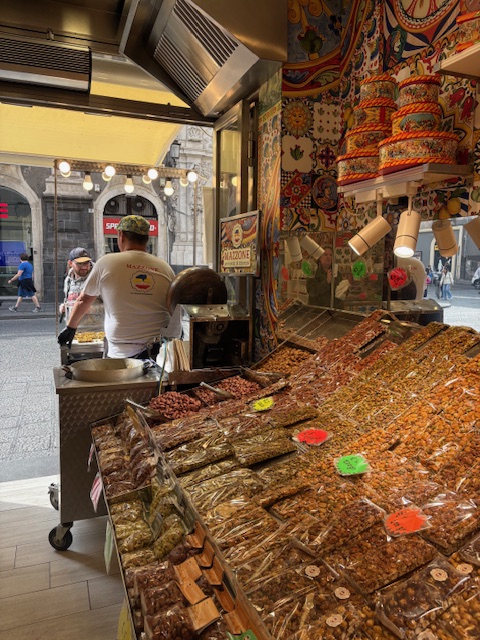
    A view inside a Mazzone location, where we bought more candied almonds.

    —Wait to rent a car until you are leaving the city. It may seem convenient to land at the Catania Fontanarossa Airport and get your rental car and then go stay in the city, right? After all, the rental car companies are all right there beside the airport. Right? Wrong. False. If you plan to stay overnight in Catania, we recommend for your own peace of mind to return to the airport area the next day and get your car. Driving in Catania seemed a bit chaotic, and I was thankful not to have to worry about driving there or find parking–especially after traveling hours to reach Sicily from the U.S. The ride from the airport to the B&B was only 15 minutes, so it’s not a huge trek back to fetch your rental car.

    —Have a little cash on hand. It’s true that we live in a cashless world, even in Sicily for the most part. However, Catania is one of those cities that charges a tourist tax. Unfortunately for everyone involved, the tourist tax can’t be charged as part of your online booking. For smaller accomodations, it’s easier for them to request that tax in cash (Euros) so they don’t have to pay expensive bank fees. I ended up having to go to an ATM to get cash, but it reminded me that I should always have some real cash on hand.

    —Enjoy trying different foods. Even if gritty urban life isn’t your thing, Catania knocks it out of the park with its food options. Whether you want to try some of the best offerings at the fish market, go exotic with the horse meat, fill up on dessert items, or just have traditional pizza and vino, it’s all there waiting for you.

    —Don’t miss Mount Etna! We said it before but we’ll say it again. Not having time for a Mount Etna tour was probably the biggest regret of my trip, so we’ll save you any heartache and say: Make time to go see this unique volcano.

    Buon viaggio!